What balance really demands - and why most seniors are told the wrong thing
Balance is not a single skill. It is a conversation between your inner ear, your eyes, the proprioceptive sensors in your joints, and the motor cortex of your brain. When any one of those channels weakens, the whole system wobbles. That is why a 70-year-old with strong legs can still feel unsteady, and why a frail 85-year-old can improve dramatically with the right kind of practice.
Most balance advice for seniors starts with standing exercises. Single-leg stands. Heel-to-toe walks. Standing marches. These are excellent for someone who can already stand without support. But what if you cannot get out of a chair without holding the armrest? What if you feel dizzy the moment you stand up? What if the fear of falling is so strong that you avoid standing altogether?
That is where gentle movement for balance in elderly adults needs to begin - not at the standing position, but at the level where the person actually is.
Why standard balance advice misses the mark for fragile seniors
The NHS, the Mayo Clinic, and countless fitness blogs publish balance exercises for older adults. Most of these lists include the same handful of movements: single-leg stands, heel raises, side leg raises, and sit-to-stand drills. They are all valuable exercises. But they share one hidden assumption: that the person can already stand safely.
According to the World Health Organization, falls are the second leading cause of unintentional injury deaths worldwide, and adults over 60 suffer the highest number of fatal falls. The fear of falling is a documented consequence of this - it creates a vicious cycle where reduced activity leads to muscle weakness, which leads to further instability, which deepens the fear.
What the standard advice misses is the psychological and cognitive dimension. Balance is not just a physical skill. It is deeply intertwined with attention, spatial awareness, and emotional state. When a senior is anxious about falling, their muscles tense, their breathing becomes shallow, and their gaze drops to the floor. All of these responses actively undermine balance.
When I first began guiding my 78-year-old aunt through balance work after her knee replacement, I made the mistake of starting with standing exercises. She could do them, barely, but she gripped the kitchen counter so hard her knuckles went white. Her breathing was shallow, her shoulders were up by her ears, and she told me afterward that she felt "like a tightrope walker without a net." I learned something important that day: balance training that ignores fear is incomplete.
That experience led me to develop what I call the Calm Balance Ladder - a progression system that starts from the safest possible position and builds up, layer by layer, addressing the physical, cognitive, and emotional components of balance together.
The Calm Balance Ladder: a framework for progressive balance training
The ladder has three rungs. Each rung builds on the previous one, and there is no shame in staying on a lower rung for weeks or months. The goal is not to rush to the top. The goal is to feel steady and confident at whatever level you are at.
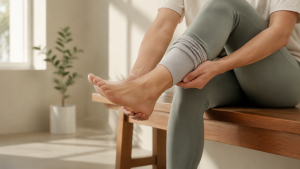
Rung 1: Seated micro-movement and breathwork. This is for seniors who are bed-bound, chair-bound, or who feel too unsteady to stand. It involves slow, deliberate movements of the ankles, knees, hips, and torso while seated, paired with diaphragmatic breathing. The goal is to re-establish the mind-body connection and wake up the proprioceptive system.
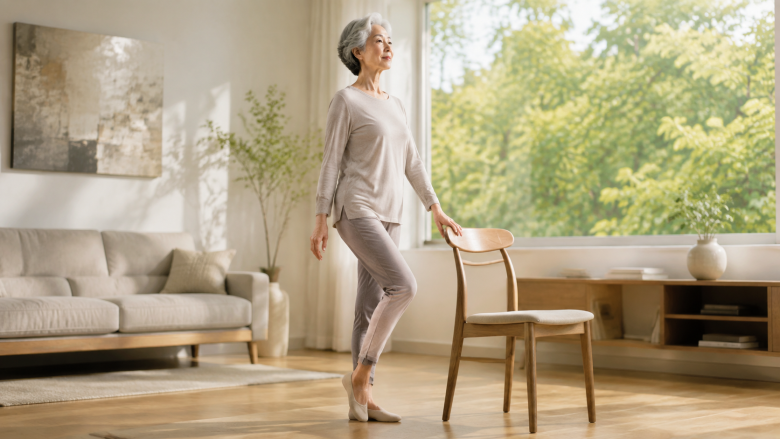
Rung 2: Supported standing and weight shifting. This is for seniors who can stand but need support. It involves holding onto a stable surface - a kitchen counter, a sturdy chair back, or a walker - while performing gentle weight shifts, heel raises, and small stepping movements. The goal is to rebuild confidence in standing and improve ankle strength.
Rung 3: Dual-task balance and cognitive-motor integration. This is for seniors who can stand independently but need to handle real-world situations where balance competes with other demands - like carrying groceries, talking while walking, or turning to look behind them. The goal is to train the brain to manage balance while doing something else at the same time.
This framework is different from standard balance advice because it does not assume a starting point. It meets the person where they are.
Rung 1: Seated micro-movement and breathwork
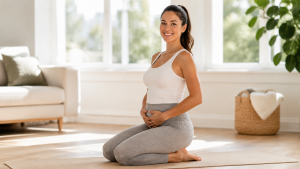
If you can only do one thing for your balance, start with your breath. This is not a metaphor - it is physiology. Diaphragmatic breathing activates the parasympathetic nervous system, which lowers heart rate and blood pressure. When the body is in a calm state, the vestibular system and proprioceptive system communicate more effectively with the brain.
Here is how to begin. Sit in a chair with your feet flat on the floor and your hands resting on your thighs. Close your eyes if that feels comfortable. Breathe in slowly through your nose for a count of four, letting your belly expand. Hold for a count of two. Exhale slowly through your mouth for a count of six. Repeat for five full cycles.
Most people don't realize that the exhale is the more important half of the breath. A longer exhale activates the vagus nerve, which is the body's primary "rest and digest" pathway. When your breath is calm, your balance system literally works better. Try this: stand up and check your balance. Then sit down, do five slow breaths with a long exhale, stand up again. Most people feel noticeably steadier the second time.
Once the breath is steady, add micro-movements. Start with ankle pumps - point your toes toward the floor, then flex them back toward your shins. Do ten slow repetitions on each foot. This activates the calf muscles and the proprioceptive sensors in the ankle joint, which are critical for balance. Then add seated marches - lift one knee a few inches, lower it, lift the other. Keep the movement slow and controlled. The goal is not speed; it is precision.
You can also practice seated weight shifting. Sit tall with your hands on your thighs. Shift your weight gently to your right sit bone, then to your left sit bone. Think of it as rocking side to side. This trains the hip and pelvic muscles that control your center of gravity.
One thing that can go wrong here: people tend to hold their breath during movement. This creates tension and defeats the purpose. Remind yourself - or your loved one - to breathe continuously. If you notice the shoulders creeping up toward the ears, pause and take three slow breaths before continuing.
What to expect in the first two weeks
In the first two weeks of Rung 1 practice, you may not notice dramatic improvements in standing balance. That is normal. What you may notice is better body awareness - a sense of where your feet are in space, or a feeling of "groundedness" when you sit. These are the foundations that standing balance will eventually build on.
Try to practice Rung 1 for ten minutes, twice a day. Morning and late afternoon tend to work well. If ten minutes feels too long, start with five. Consistency matters far more than duration.
Rung 2: Supported standing and weight shifting
When you can sit through a full Rung 1 session without feeling breathless or unsteady, it is time to try Rung 2. This rung moves you to standing, but with the support of a stable surface.
Place both hands on a kitchen counter, a sturdy table, or the back of a heavy chair. Your feet should be hip-width apart, toes pointing forward. Now shift your weight gently to your right foot, then to your left foot. The movement should be small - no more than a few inches of travel. Keep your shoulders relaxed and your gaze forward.
This simple weight-shifting exercise does more than strengthen the legs. It trains the vestibular system to interpret small changes in body position, which is exactly what your brain needs to prevent a fall. The support of the counter means there is zero risk of falling while you practice.
Once weight shifting feels comfortable, add heel raises. Hold the counter with one hand, lift both heels off the floor as high as comfortable, then lower them slowly. Do ten repetitions. This strengthens the calf muscles, which are among the most important muscles for balance. Weak calves are a major contributor to falls in older adults, and yet they are rarely targeted in standard balance programs.
After heel raises, try standing marches. Hold the counter with both hands, lift one knee to hip height - or as high as you can manage - hold for two seconds, and lower it. Alternate legs for ten total repetitions. The key is to keep your torso tall and your gaze forward. Do not look down at your feet. Looking down shifts your center of gravity forward and actually makes balance worse.
Why the fear of falling makes this rung harder than it looks
Here is what nobody tells you about supported standing: the physical demands are minimal, but the psychological demands are significant. For a senior who has not stood without help in months, even holding onto a counter can trigger anxiety.
This is where the breathwork from Rung 1 becomes your most valuable tool. Before you begin Rung 2 exercises, do three slow breaths with a long exhale. As you shift your weight, keep breathing. If you feel your shoulders tensing or your grip tightening on the counter, pause and take three more breaths.
I worked with an 84-year-old man who had not stood independently for six months after a bad fall. When we first tried Rung 2, he gripped the counter so hard that his knuckles were white within thirty seconds. We spent the first week just breathing while standing, letting his body remember what it felt like to be upright without panic. By the end of the second week, he was doing weight shifts. By the end of the month, he was doing heel raises.
The lesson: the ladder is not a race. If you need to spend two weeks just standing at the counter and breathing, that is time well spent.
Rung 3: Dual-task balance and cognitive-motor integration
Here is a disturbing statistic: most falls in older adults happen during everyday activities, not during exercise. A senior who can stand perfectly still on one leg in a clinical setting can still fall while reaching for a plate in the kitchen. Why? Because real-world balance never happens in isolation. You are always balancing while doing something else - reaching, turning, talking, thinking.
This is where dual-task balance training comes in. Dual-tasking means performing a balance exercise while simultaneously doing a cognitive task. The research is clear: older adults who practice dual-task training show significant improvements in gait and balance compared to those who only do single-task training. The CDC emphasizes that fall prevention requires addressing multiple risk factors, including cognitive function, not just physical strength.
Here is a progression of dual-task exercises that build on the movements from Rung 2:
- March and count: Stand at the counter, marching in place. While you march, count backward from twenty by twos. The counting forces your brain to divide attention between the physical task and the cognitive task.
- March and pass: Stand at the counter with a small ball - a tennis ball or a soft exercise ball. March in place while passing the ball from one hand to the other in front of your chest. The arm movement adds a third demand on your balance system.
- Weight shift and name: Shift your weight from side to side while naming the months of the year in reverse order. This is harder than it sounds, and that is exactly the point.
- Heel raise and recite: Do heel raises while reciting a poem, a prayer, or the alphabet backward. The recitation prevents you from focusing entirely on the physical movement.
The key principle is progressive overload - but applied to the brain, not just the muscles. Start with easy cognitive tasks, like counting forward from one to ten. As that becomes easy, switch to backward counting, then to naming things, then to more complex tasks.
What can go wrong with dual-task training
The biggest risk with dual-task training is pushing too hard, too fast. If the cognitive task is too demanding, the senior will unconsciously sacrifice form on the physical movement. You may see them start leaning on the counter more heavily, or their steps may become smaller and less controlled.
Here is the rule I use: if the physical movement degrades noticeably while doing the cognitive task, the task is too hard. Step back to an easier cognitive task, or go back to single-task practice for a few sessions.
Another common mistake is choosing cognitive tasks that are too abstract. Reciting the alphabet backward is a good test of cognitive function, but it does not mimic real-world demands. A more functional cognitive task might be: "While you march, tell me what you need to buy at the grocery store." This mimics the real-world scenario of planning while walking.
The fear of falling: the invisible barrier to progress
Up to 50% of older adults who have fallen report a fear of falling, and many who have never fallen also experience this fear. The fear is not irrational - it is a protective response. But when it becomes overwhelming, it leads to a cascade of physical decline.
The National Institute on Aging notes that fear of falling can cause older adults to limit their activities, which leads to muscle weakness, reduced flexibility, and impaired balance - which in turn increases the actual risk of falling. It is a self-fulfilling prophecy.
The Calm Balance Ladder addresses this directly by making every exercise feel safe. There is always a support surface. There is always a way to stop. The breathwork ensures that the nervous system stays calm. And the gradual progression means that confidence is built on actual competence, not on wishful thinking.
One technique I use with clients who have a strong fear of falling is anchoring. Before each exercise, I ask them to identify three things they can feel: their feet on the floor, their hands on the support surface, and their breath moving in and out. This simple grounding practice takes about thirty seconds and dramatically reduces anxiety before movement.
Another technique is to verbalize the fear. Ask the senior: "What exactly are you afraid of?" The answer is often vague - "I might fall" - which is not actionable. But when you break it down - "I'm afraid I won't be able to get back up" or "I'm afraid I'll break my hip" - you can address the specific concern. For "I won't be able to get back up," practice getting down to the floor and back up in a controlled way. For "I'll break my hip," work on building bone density through weight-bearing exercises.
The most important shift happens when a senior moves from "I am afraid of falling" to "I know what to do when I feel unsteady." That is the moment the ladder starts working.
Safety rules and when to advance
Before you start any balance program, there are a few non-negotiable safety rules. These are the things I wish someone had told me when I first started teaching balance work.
- Always have a support surface within reach. Even if you are doing Rung 1 seated exercises, have a sturdy chair or table nearby in case you feel dizzy.
- Never do balance exercises on a slippery surface. Use a yoga mat or non-slip rug if you are working on a hard floor.
- Do not close your eyes during standing exercises unless you are specifically trained to do so. Closing your eyes removes visual input, which is one of your primary balance systems.
- Stop immediately if you feel dizzy, lightheaded, or short of breath. These are warning signs that something is wrong. Do not push through them.
- Wear supportive shoes. Slippers and bare feet are fine for seated exercises, but for standing work, wear shoes with non-slip soles.
How do you know when it is time to advance to the next rung? Here is my rule of thumb: you are ready to move up when you can complete the current rung's exercises with good form, without gripping the support surface, and without any increase in anxiety. If you are still white-knuckling the counter, stay on the current rung.
It is also worth noting that balance training is not a linear progression. You may have a great week on Rung 3, then have a bad night of sleep and need to drop back to Rung 1 the next day. This is normal. The ladder is not a staircase; it is more like a tide that comes in and goes out. Honor where you are on any given day.
A sample week of Calm Balance practice
Here is what a week of Calm Balance might look like for someone working through the ladder. This is a template, not a prescription - adjust the timing and intensity to match your energy level and abilities.
Monday: Rung 1 - 10 minutes of seated breathwork and ankle pumps, followed by 5 minutes of seated weight shifting. Evening: 5 minutes of breathwork before bed.
Tuesday: Rung 2 - 10 minutes of supported standing: weight shifts, heel raises, and standing marches at the counter. Use the anchoring technique before you begin.
Wednesday: Rest day. Light stretching if you feel stiff, but no structured balance work. The body needs recovery time.
Thursday: Rung 2 - repeat Tuesday's session, but add one dual-task element: count backward from twenty while doing standing marches.
Friday: Rung 3 - 10 minutes of dual-task work: march while passing a ball, weight shift while naming the months backward. Keep the cognitive tasks easy enough that your physical form does not degrade.
Saturday: Rung 1 - a longer seated session. 15 minutes of breathwork, ankle pumps, and seated weight shifting. Add a mindfulness component: notice the sensations in your feet and legs as you move.
Sunday: Rest day. Walk around the house if you feel steady, but no structured exercises.
For a more structured approach to building a daily movement habit, our 30-Day Gentle Movement Plan for Beginners pairs well with the Calm Balance Ladder. It gives you a day-by-day framework for staying consistent, which is the single most important factor in any balance program.
The role of mindfulness in balance training
Mindfulness is not a wellness buzzword in this context - it is a practical tool. When you are mindful of your body, you notice small shifts in your center of gravity before they become large enough to cause a fall. You notice when your breathing becomes shallow. You notice when you are gripping a support surface too tightly.
The same principle applies to how we manage our attention throughout the day. Just as we need to balance screen time with fresh air breaks, as discussed in our guide on balancing screen time with outdoor time, we need to balance cognitive effort with physical awareness. A few minutes of mindful breathing and body scanning each day can rewire how your brain processes balance-related sensory information.
The bigger picture: why balance training is never just about balance
When you practice gentle movement for balance, you are not just training your muscles. You are training your vestibular system, your visual system, your proprioceptive system, and your cognitive processing. You are also training your emotional regulation - learning to stay calm in situations that once triggered panic.
This is why I emphasize the calm in Calm Balance. A senior who can breathe slowly and deliberately while standing at the counter is not just practicing balance. They are practicing the skill of staying composed under pressure. And that skill transfers to every aspect of daily life - walking on uneven sidewalks, navigating crowded rooms, getting in and out of a car.
The evidence supports this broader view. A meta-analysis published in the Journal of the American Geriatrics Society found that exercise programs that combined balance training with cognitive elements were more effective at reducing fall risk than balance training alone. The CDC's STEADI initiative (Stopping Elderly Accidents, Deaths, and Injuries) similarly recommends a multifaceted approach that includes both physical and cognitive components.
Final thoughts: start where you are
The most important thing I can tell you about gentle movement for balance in elderly adults is this: it is never too late to start, and you do not need to be able to stand to begin. Whether you are working from a bed, a chair, or a kitchen counter, there is a rung of the ladder that fits where you are right now.
Start with your breath. Move slowly. Keep your eyes forward. And do not measure progress against anyone else's timeline.
If you take one thing from this article, let it be this: balance is not a destination you arrive at. It is a daily practice, like brushing your teeth or drinking water. Ten minutes of focused, calm movement every day will do more for your balance - and your confidence - than an hour of intense exercise once a week.
The ladder is always there. Take the first step today.