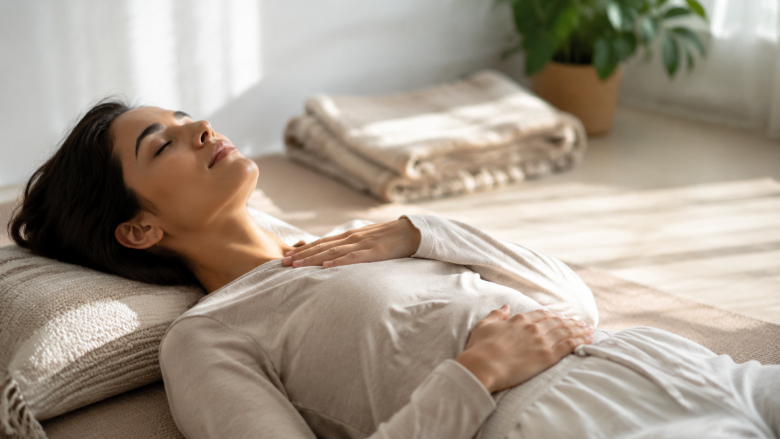
When Stress Hits, Your Brain Is Not the Problem
If you are reading this because your chest is tight and your mind is racing, here is the answer you need right now: the fastest way to relieve stress with a body scan is not to clear your mind. It is to move your attention to your feet for 90 seconds. That is it. That is the whole secret that most guided meditations miss.
When I first started practicing body scan meditation, I made the mistake of trying to force relaxation. I would lie down, close my eyes, and attempt to "let go" of the tension in my shoulders. It never worked because I was using my thinking brain to fix a problem that lives in my nervous system. The body scan is not a thought exercise. It is a physiological intervention that uses your attention as a tool to activate the vagus nerve and shift your body out of a stress response.
In this guide, I will walk you through the exact protocol I use with clients during acute stress spikes, explain the science of why it works (including the vagal tone mechanism), and give you a troubleshooting section for every way it can go wrong - because it will go wrong at first.
The Physiology: Why the Body Scan Works (The Vagus Nerve)
Most articles tell you that a body scan "promotes relaxation" without explaining the machinery. Here is the non-negotiable science part, kept short and practical.
The autonomic nervous system has two branches that matter here: the sympathetic (fight-or-flight, which releases cortisol and adrenaline) and the parasympathetic (rest-and-digest, which slows your heart rate and lowers blood pressure). The primary highway for the parasympathetic system is the vagus nerve, which runs from your brainstem down to your abdomen, touching your heart, lungs, and digestive tract along the way.
The body scan works because it forces your brain to allocate attention to specific body parts. When you deliberately focus on your left foot, your brain sends a signal down that neural pathway. That signal competes with the sympathetic alarm signals. It is a bit like holding down a key on a piano - the stress note keeps trying to play, but you are physically holding the key for the calm note instead.
The key metric here is vagal tone, which is essentially a measure of how quickly your heart rate can slow down after a challenge. Higher vagal tone is associated with better emotional regulation and faster stress recovery. Here is what nobody tells you: you cannot directly control your vagal tone with a single session. But you can build it over time, like a muscle, by repeatedly practicing attention-based techniques like the body scan.
The Difference Between Acute and Chronic Stress
You need to know which type of stress you are treating, because the protocol is different.
- Acute stress spike: A sudden panic attack, a fight with a partner, a work email that makes your stomach drop. Your heart rate is over 100. Your hands are shaking.
- Chronic stress: The low-grade background hum of daily tension. You are not panicking, but you cannot fully relax either. You feel tight in the jaw, shoulders, and lower back all day.
The 90-second micro-scan I describe below is designed for acute spikes. For chronic tension, you need a longer practice (10+ minutes) done consistently. I almost exclusively use the micro-scan in my own life when I feel the cortisol spike hit - it is faster than finding a quiet room and putting on headphones.
The 90-Second Micro-Scan: A Protocol for Acute Stress Spikes
I developed this protocol out of necessity. I was seeing a therapist years ago for anxiety, and she taught me a traditional body scan. It took 20 minutes. I am a busy working professional and a parent, and I do not always have 20 minutes when I am standing in a grocery store line and my vision starts to blur from a panic wave.
Here is the exact protocol I now use. It takes 90 seconds and you can do it with your eyes open, standing up, in a meeting, or in a crowded subway.
- Ground your feet (0-15 seconds). Press your feet flat into the floor. Do not look down. Feel the weight of your body sinking into your heels. If you are sitting, press your thighs into the chair. If standing, shift your weight slightly forward and back to feel the pressure change.
- Drop your attention to your toes (15-30 seconds). This is the critical step. Do not scan from head to toe. Start at the bottom. Move your attention to the toes of your left foot. Just notice the sensations - tingling, warmth, the fabric of your sock. Do not try to relax them. Just observe them.
- Move to your ankles and calves (30-50 seconds). Slowly move your attention up to your ankle joint, then the calf muscle. Notice if there is any tightness. Do not judge it. Say to yourself, "This is what a tight calf feels like." This labeling action is what keeps your thinking brain occupied.
- Finish at your knees (50-90 seconds). End at your knees. Do not go higher. I know it feels arbitrary, but the act of stopping at the knees is what teaches your brain that you are in control of where attention goes. If you have time, do the same on the right leg.
The rule is simple: When the mind is loud, go low. The further away from your head you put your attention, the faster the nervous system downshifts.
Why does this work for acute spikes? Because when you are panicking, your brain is fixated on a threat - real or imagined. By forcing attention to your feet, you are physically interrupting the threat-detection loop. You are not trying to suppress the panic; you are just giving your brain a different, more boring task to do. It is like a bouncer redirecting a drunk person out of the club - you are not arguing with the drunk person, you are just pointing them to the door.
What to Do If 90 Seconds Is Not Enough
Sometimes the spike is too large, and 90 seconds will not bring you all the way down. That is fine. Do not fight it. If your heart rate is still above 90 after the micro-scan, do a second round. Start at the feet again but this time include the hips and lower belly. If you are still elevated after three rounds, you need to move your body - stand up and walk around the block. The body scan is a tool, not a magic wand. It can take the edge off, but a massive adrenaline dump often requires physical movement to metabolize.
Troubleshooting: When the Body Scan Fails (And What to Do)
I have taught this to hundreds of people, and I can predict exactly which problems they will hit. Here is the fix for each one.
Problem 1: Your Mind Keeps Wandering
This is the number one complaint. You try to focus on your toes, and suddenly you are mentally rehashing a conversation from three days ago. The instinct is to get frustrated and yank your attention back. That is wrong.
When you notice your mind wandered, do not pull it back. Instead, label the thought and let it go. Say in your head, "Thinking," and then return to the toes. If you have to do this 50 times in 90 seconds, that is a success, not a failure. The act of noticing the wandering and returning is the actual exercise. The focusing is just a byproduct. Most people do not realize that the "reps" of catching yourself wandering are what build the neural pathway, not the moments of perfect focus.
Problem 2: You Fall Asleep
If you are doing the body scan lying down in bed, there is a high chance you will fall asleep, especially if you are chronically exhausted. This is not a failure of the technique, but it is a failure of the goal if you are trying to stay alert.
The fix is simple: keep your eyes slightly open. Not fully open, just a crack - a 10% opening. This keeps your brain in a state of relaxed alertness. Also, sit on the edge of a chair with your feet flat on the floor. Do not do the body scan lying down unless you are explicitly using it to fall asleep. For stress relief during the day, posture matters more than you think.
Problem 3: You Feel Restless or Agitated
Sometimes, when you direct attention to a tense area, the tension amplifies before it releases. This is a real phenomenon called somatic tracking, and it is common in people with anxiety. You feel a tight chest, you focus on it, and it gets tighter.
If this happens, do not push through. Move your attention to a neutral area, like your left earlobe or the tip of your nose. Do not focus on the area that is causing distress. The point is not to "fix" the tension; the point is to prove to your brain that you can choose where attention goes. Once you have that control, you can gently touch the tense area for a few seconds, then go back to the neutral area. This is called pendulation, and it is the secret to using body scans for trauma-sensitive practices.
Extending the Practice: The 10-Minute Chronic Stress Protocol
For daily background tension, the 90-second micro-scan is not enough. You need a longer, more thorough scan to release the deep-held tension in your hips and shoulders. I recommend doing this in the morning before you look at your phone, or in the evening before dinner (not right before bed, unless you want to fall asleep).
Here is my 10-minute protocol that goes beyond the typical "relax your forehead" instruction:
- Start with your breath (2 minutes). Sit upright in a chair. Take 5 slow breaths. Exhale for twice as long as you inhale (inhale 4 counts, exhale 8 counts). This is the only breathing pattern I use, because it directly stimulates the vagus nerve.
- Scan the back of your body (3 minutes). Start at the heels, move up the back of the legs, into the lower back and spine. This is the side of the body that holds postural stress. Notice if your lower back is bracing as if preparing for impact.
- Scan the front of your body (3 minutes). From the toes, up the shins, into the belly, chest, and throat. The throat is a big one - most people hold tension there without realizing it. Notice if your jaw is clenched.
- Scan the head and face (2 minutes). End at the jaw, eyes, and forehead. Instead of trying to "soften" the forehead, just notice the sensation of the skin. Often, the simple act of noticing causes a release.
This longer protocol is better for building vagal tone because it keeps your attention moving for a sustained period. It is like a slow jog for your nervous system, whereas the micro-scan is a sprint.
My Personal Experience with the 10-Minute Protocol
When I first started doing this consistently, I was shocked at where the tension was hiding. I had been doing yoga for years, so I thought I was pretty good at relaxing. But when I scanned the back of my body, I found that my lower back was permanently braced, as if I was expecting to be hit. It took about three weeks of daily 10-minute scans to get that area to release. The thing nobody tells you about body scans is that you will often find tension you did not know you had. It is not always a pleasant experience. Sometimes it brings up sadness or anger. That is normal. If you feel an emotion arise, just label it ("sadness") and continue scanning. Do not get lost in the story.
How to Build a Sustainable Practice (Without It Becoming a Chore)
The biggest reason body scan programs fail is that people treat it like a rigorous exercise routine. They schedule 20 minutes, buy a special cushion, and download a fancy app. Then they miss one day, feel guilty, and quit.
Here is the honest truth: you do not need any of that. You need two things - a trigger and a location.
- Trigger: Pick a daily event that always happens, like brushing your teeth or waiting for your coffee to brew. Do the 90-second micro-scan during that time. Do not try to find extra time; just piggyback on an existing habit.
- Location: Do the longer 10-minute protocol in the same chair every day. Within a week, your brain will associate that chair with a calming response. It becomes a conditioned trigger. When you sit down, your nervous system starts to downshift before you even begin.
I have a client who does her micro-scan while the traffic light is red on her commute. She said it was the only way she could fit it into her schedule. She has been doing it for two years now. Consistency beats intensity every single time.
If you find yourself reaching for food when stressed, a body scan can also be a powerful tool to interrupt that pattern. It creates a pause between the urge and the action. For a deeper look at that specific dynamic, see our guide on evening stress eating and gentler habits to build.
What to Expect (And What Not to Expect)
I want to be honest about the limitations of the body scan, because overhyping it is a disservice to you.
What it does: It lowers your heart rate, reduces muscle tension, gives your mind a break from rumination, and over time, improves your baseline vagal tone. It is excellent for managing day-to-day stress and for taking the edge off a panic spike.
What it does not do: It does not cure anxiety disorders, it does not resolve trauma, and it is not a substitute for medical treatment if you have chronic pain or a serious mental health condition. If you are having panic attacks multiple times a week, or if your stress is accompanied by depression or suicidal thoughts, you need to speak to a licensed therapist or psychiatrist. A body scan is a self-regulation tool, not a medical treatment.
Also, do not expect a linear progression. Some days, a 90-second scan will feel like a miracle. Other days, you will do the full 10 minutes and feel nothing. That is normal. The goal is not to feel calm every time. The goal is to build the skill of shifting attention. The calm is a side effect.
Frequently Asked Questions
Can I do a body scan while walking?
Yes. A walking body scan is a variation that involves focusing on the sensation of your feet hitting the ground. It is not as deep as a seated scan, but it is an excellent way to practice mindfulness if you cannot sit still. I recommend it for people who find seated meditation too activating.
What if I feel pain when I scan?
Do not push into sharp pain. If you feel a sharp twinge, move your attention away. For chronic pain, a body scan can be helpful, but it should be done carefully. The goal is to notice the sensation, not to fix it. If the pain is severe, consult a medical professional.
Is it better to do a body scan in the morning or at night?
Morning is better for building a practice and managing daytime stress. Night is better if you are using it to fall asleep. The micro-scan is good for any time of day, especially in the middle of a stressful event.
How long does it take to see results?
You will likely feel a temporary decrease in stress after your first session. For lasting changes in your baseline stress level, you need to practice for at least 2-3 weeks, daily if possible. That is the timeframe in which you start to build new neural pathways.
Your Next Step: Do It Now
Do not close this article and say you will try it later. That is your stress talking. Right now, as you are reading this, press your feet into the floor. Feel your heels. Move your attention to your left big toe. Just for 10 seconds. Notice the sensation. That is the entire foundation of the practice.
The science is sound, the protocol is simple, and the only thing standing between you and a calmer nervous system is the decision to shift your attention downward. The 90-second micro-scan is not a magic cure, but it is a reliable, portable, and evidence-backed tool that you can use in the exact moment you need it most. Start small. Start low. And let your feet do the heavy lifting.