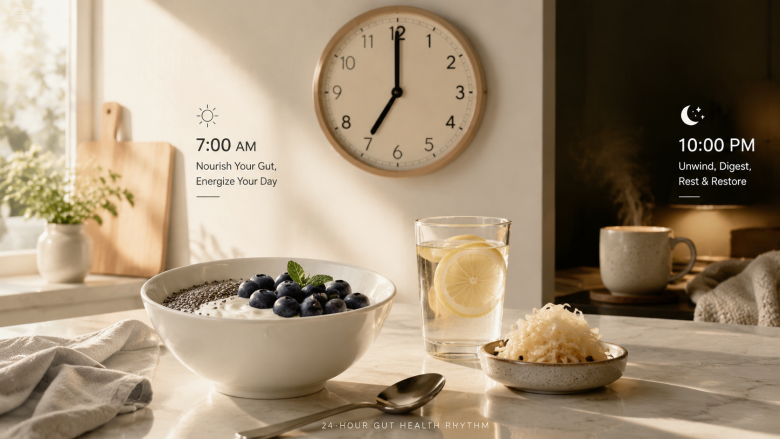
The Problem With Morning-Only Gut Advice
Most gut health articles stop at lunch. They tell you to drink warm lemon water, eat oatmeal, take a walk, and call it a day. But your gut does not operate on a morning-only schedule. It runs on a roughly 24-hour biological clock, and what you do at 9 p.m. matters just as much as what you do at 9 a.m.
The daily routine for better gut health that actually works is a full-day rhythm: a gentle morning activation, a strict evening wind-down, and a fiber ramp that does not leave you bloated and miserable. This is the approach I use with clients who have tried every supplement on the shelf and still feel heavy, irregular, or sluggish.
Here is the short version: wake up at a consistent time, drink water before caffeine, eat your first meal within 90 minutes of waking, take a 10-minute walk after breakfast to trigger the gastrocolic reflex, stop eating 3 hours before bed, and go to sleep at the same time every night. The rest of this article explains why each step matters and how to adapt it to your life without turning into a wellness-obsessed hermit.
Why Your Gut Has a Clock (and Why It Matters)
Your gut is not a passive tube that just processes whatever you throw at it. It has its own circadian rhythm, synchronized with your brain and your eating patterns. This rhythm influences everything: how fast food moves through you, how well you absorb nutrients, and which gut bacteria thrive.
When I say "circadian alignment," I mean eating and sleeping at times that match your body's natural biological day. Research from the National Institute of General Medical Sciences shows that nearly every tissue in your body has its own clock, including your intestines. When those clocks are out of sync, digestion slows down and gut motility suffers.
Here is the thing nobody tells you: your gut microbiome is also rhythmic. The bacteria in your colon fluctuate in abundance over a 24-hour period. Some species are more active during the day, others at night. When you eat late at night, you feed the nocturnal bacteria, which can shift the balance of your microbiome in ways that promote inflammation and weight gain. This is not about morality or willpower. It is about working with your biology instead of against it.
The Gastrocolic Reflex: Your Morning Bathroom Window
The gastrocolic reflex is a physiological response where stretching your stomach after eating triggers a wave of contraction in your colon. It is strongest in the morning, especially after your first meal. This is why many people feel the urge to use the bathroom shortly after breakfast.
Most gut health advice ignores this reflex entirely. They focus on fiber and probiotics but never tell you to exploit your body's natural morning window for bowel regularity. Here is how you use it: drink water first, then eat within 90 minutes of waking, then go for a short walk. The combination of food in the stomach, upright posture, and rhythmic movement creates the ideal conditions for a bowel movement.
When I first tried this, I made the mistake of chugging coffee immediately after waking and skipping breakfast. Coffee does stimulate the colon, but it also spikes cortisol and can cause loose stools if you drink it on an empty stomach. What I learned: hydration, then food, then movement, then coffee. That order changed everything for me.
The Morning Activation (0-3 Hours After Waking)
The morning portion of this routine is not complicated, but it is specific. You do not need a 12-step wellness ritual. You need four things: water, light, food, and movement. Here is the exact sequence I recommend.
Step 1: Water Before Anything Else
When you wake up, you are mildly dehydrated. Your digestive tract needs water to produce stomach acid, enzymes, and mucus. Without adequate hydration, food sits in your stomach longer and fermentation happens in the wrong place.
Start with 300-500 ml of room-temperature water. Add a squeeze of lemon if you like the taste, but know this: lemon water is not a magic detoxifier. Your liver does the detoxifying. What lemon water actually does is give you a small dose of vitamin C and gently stimulate digestive secretions. If you hate lemon, plain water works just as well.
Wait 15-20 minutes before drinking coffee or tea, and eat something before your caffeine. This is non-negotiable if you have a sensitive stomach, acid reflux, or a tendency toward anxiety.
Step 2: Morning Light Exposure
Light is the primary Zeitgeber, or "time-giver," for your circadian rhythm. Getting bright light in your eyes within the first hour of waking sends a signal to your suprachiasmatic nucleus, which then coordinates your gut clock.
Go outside for 5-10 minutes if you can. If you live somewhere with limited morning light, a bright light therapy lamp can work. This is not about vitamin D synthesis. It is about telling your entire system, including your gut, that the biological day has started.
Most people miss this step because it sounds too simple. But light exposure is arguably more important than any supplement for aligning your gut rhythm.
Step 3: A Fiber-Rich Breakfast (But Not Too Much Fiber)
Breakfast is the meal that sets the tone for your gut. The goal is not a massive bowl of raw oats with chia seeds and berries, which is a recipe for bloating if your gut is not used to it. The goal is a moderate, balanced meal with 8-12 grams of fiber, some protein, and minimal added sugar.
A good template: cooked oatmeal with a spoonful of ground flaxseed and a sliced banana, or two scrambled eggs with sauteed spinach and a slice of sourdough toast. Both give you soluble fiber, which feeds beneficial bacteria without causing excessive gas.
If you are new to high-fiber breakfasts, start smaller. Half a cup of oatmeal, not a full bowl. Your gut bacteria need time to adjust to new inputs. We will get into the specifics of fiber ramping later.
Step 4: The 10-Minute Morning Walk
Walking after breakfast is the single most underrated habit for gut health. It stimulates the gastrocolic reflex, improves gastric emptying, and reduces post-meal blood sugar spikes. It does not need to be intense. A gentle 10-minute walk is enough.
When I work with clients who struggle with constipation, I tell them to do this before anything else. No workouts, no cardio, no intense exercise. Just a slow walk around the block within 30 minutes of eating. For many people, this is the difference between daily bowel movements and three-day gaps.
I have also found that this walk is a good place to practice a little mindfulness. Pay attention to the feeling of your feet on the ground, the temperature of the air, the sounds around you. Stress is a major gut disruptor, and starting your day with a low-stress walk helps keep your parasympathetic nervous system engaged.
Midday and Afternoon: Sustaining the Rhythm
The middle of the day is where most routines fall apart. You get busy, skip lunch, or eat something processed at your desk. These habits are not just bad for your gut because of the food quality. They also disrupt the timing signals that your gut uses to coordinate digestion.
Eat Your Biggest Meal at Lunch, Not Dinner
Your gut's digestive capacity follows a circadian pattern. Enzyme secretion, bile production, and intestinal motility are all higher in the morning and early afternoon. Eating a larger meal at lunch, when your digestive system is most active, aligns with your biology better than eating a huge dinner at 8 p.m.
This does not mean you need to eat like a bird at dinner. It means shifting the balance. If you usually eat a small salad for lunch and a massive dinner, try swapping them for a week. Most people report less bloating at night and better sleep.
The research on time-restricted eating supports this. Studies like those from the National Heart, Lung, and Blood Institute emphasize that meal timing and composition work together. You cannot out-supplement a habit of eating 60% of your calories after 7 p.m.
Protein and Fermented Foods: When and How
Protein is important for gut lining repair and enzyme production, but too much protein at one sitting can cause bloating and slow transit time. Aim for 20-30 grams of protein at lunch and a smaller portion at dinner.
Fermented foods like yogurt, kefir, kimchi, and sauerkraut are excellent for microbiome diversity, but there is a catch: if you eat them all at once, your gut will protest. Start with one to two tablespoons of sauerkraut or a small cup of kefir, not a full bowl. The key is gradual introduction.
A common mistake I see is people eating Greek yogurt every morning AND taking a probiotic supplement AND drinking kombucha at lunch. That is a lot of microbial load for your gut to handle at once. Choose one or two fermented foods and cycle them throughout the week.
Hydration: The Afternoon Slump Is Often Thirst
Many people mistake thirst for hunger or fatigue. Their gut motility slows down, they feel sluggish, and they reach for a snack or another coffee. Often, they are just dehydrated.
Keep a water bottle at your desk and aim for 1.5 to 2 liters of total fluid per day, spread out across the afternoon. Herbal teas like ginger, peppermint, or fennel count toward this total and can also soothe digestion after lunch.
One note: do not drink a full glass of water with your meals. This dilutes stomach acid and can slow digestion. Drink most of your fluids between meals, and only sip small amounts while eating.
The Evening Wind-Down: The Missing Half of the Routine
Here is where this article differs from almost every other gut health routine you will read. The evening is not just a time to relax. It is a critical window where you decide whether your gut gets proper rest or gets disrupted by late-night snacking and poor sleep.
Your gut needs a fasting period overnight. This is not about calorie restriction or weight loss. It is about giving your migrating motor complex (MMC) a chance to do its job. The MMC is a sweeping wave of electrical activity that clears undigested food and bacteria from your small intestine. It only runs when you have been fasting for at least 2-3 hours, and it is strongest at night.
If you eat a bag of chips at 11 p.m., you reset that fasting clock and rob your gut of its cleaning cycle. This is the thing nobody tells you about gut health: the overnight fast is not just about "not eating." It is an active physiological process that your gut needs, like a nightly garbage collection service.
Early Dinner: The 3-Hour Rule
Finish your last meal at least 3 hours before bedtime. If you go to bed at 10:30 p.m., that means dinner is done by 7:30 p.m. This is the single highest-impact change you can make for better gut health.
Why 3 hours? It takes roughly that long for the stomach to empty its contents into the small intestine. If you lie down with food still in your stomach, acid reflux and heartburn are more likely, and your gut cannot properly process the food. This is also why late eating is associated with worse blood sugar control and more fat storage.
I know this is hard for people with late work schedules or social obligations. I have been there. The compromise: if you absolutely must eat late, choose something small and low-fat like a piece of fruit or a small bowl of broth. Save the big meal for lunch. Your gut will thank you.
What to Do When You Feel Hungry at Night
Nighttime hunger is real, especially in the first few weeks of trying to stop late snacking. The urge is often a mix of habit, boredom, and low blood sugar. Here is what works:
- Drink a cup of warm herbal tea, like chamomile or peppermint. The warmth and ritual can satisfy the urge.
- Use a heat pad or hot water bottle on your abdomen. This relaxes the intestinal muscles and mimics the comforting feeling of food.
- Go to bed earlier. This sounds like cheating, but it is the most effective hack for nighttime snacking. If you are asleep, you are not eating.
- If hunger is intense, have a small spoonful of almond butter or a few soaked chia seeds. The goal is to take the edge off without triggering a full digestive response.
Most people do not realize that "nighttime munchies" after dinner are often a sign of not eating enough at lunch or dinner. When clients switch to a bigger lunch and an earlier dinner, the nighttime hunger usually disappears within a week.
Pre-Bed Habits That Support Gut Rest
Your pre-bed routine should be boring. Bright screens, intense exercise, and heavy mental stimulation keep your sympathetic nervous system active, which sends a signal to your gut that it is still daytime. That is a problem because your gut needs the parasympathetic "rest and digest" mode to repair overnight.
Try dimming the lights 30-60 minutes before bed and switching to orange-toned lighting if possible. Blue light from screens suppresses melatonin, and melatonin is not just a sleep hormone. It also regulates gut motility and supports the integrity of the intestinal lining. If you want to preserve your gut health, you need to protect your melatonin production.
For a step-by-step plan, see our article on how to build a relaxing bedtime routine. A good evening routine is not just about sleep. It is a direct extension of your gut health routine.
If you are pressed for time, a shorter version is fine. Our guide on a 15-minute evening routine for better rest covers the essentials: turn off screens, dim the lights, write down tomorrow's tasks, and do a 5-minute gentle stretch. Stretching at night helps release physical tension that can interfere with gut motility.
The Fiber Ramping Schedule: How to Avoid Bloating
Every article tells you to eat more fiber, but nobody tells you how to do it without turning into a balloon. Let me fix that.
Your gut bacteria digest fiber through fermentation, and fermentation produces gas. If you go from 15 grams of fiber per day to 40 grams overnight, the bacteria in your colon will be overwhelmed, and you will experience bloating, cramping, and maybe worse. This is not a failure of the diet. It is a failure of the transition.
The solution is a gradual fiber ramp. This is a 3-4 week schedule that gives your microbiome time to adapt and grow the necessary bacterial populations:
| Week | Starting Fiber Intake | Daily Fiber Target | Sample Meals |
|---|---|---|---|
| Week 1 | Current baseline | Baseline + 5 g | 1/2 cup oats, 1 banana, 1 cup cooked broccoli |
| Week 2 | Week 1 intake | Baseline + 10 g | Add 1 tbsp ground flaxseed or 1/2 cup lentils |
| Week 3 | Week 2 intake | Baseline + 15 g | Add 1/4 cup beans or 1 pear with skin |
| Week 4 | Week 3 intake | Baseline + 20 g | Add 1/2 cup quinoa or 2 tbsp chia seeds |
The most important rule: increase only one fiber-rich food every 3-4 days. Do not add five new high-fiber foods at once. If you do this and you still get bloated, back off for a few days and then increase more slowly.
Another thing nobody mentions: the form of fiber matters. Soluble fiber (oats, bananas, psyllium) dissolves in water and gels in your gut, which is generally gentler. Insoluble fiber (wheat bran, raw vegetables) adds bulk and can be irritating if you increase it too fast. Start with soluble fiber first, then layer in insoluble fiber.
The Fiber Adaptation Misconception
There is a widespread belief that any bloating from increased fiber is temporary and you just need to push through it. That is true for mild bloating that subsides after 2-3 weeks. It is not true for severe pain or cramping.
If you experience sharp abdominal pain, significant bloating that lasts all day, or a sudden change in bowel habits, stop increasing fiber and check for underlying issues. Fiber is not universally good for everyone. People with gastroparesis, severe IBS, or a history of bowel obstruction may need a completely different approach. Work with a clinician if that is you.
The honest truth is that fiber is not a cure-all. It is a tool. Used correctly, it feeds your beneficial gut bacteria and bulks up stool. Used carelessly, it causes pain and makes you swear off healthy eating forever.
Adapting the Routine to Different Lifestyles
Not everyone works a 9-to-5 job with a predictable schedule. Night shift workers, new parents, and frequent travelers face unique challenges. The 24-hour circadian gut reset needs to be adapted to your reality, not the other way around.
For Shift Workers: Anchor to Your Wake-Up Time
If you work nights and sleep during the day, your circadian rhythm is already misaligned with the sun. The best you can do is anchor your routine to your own wake-up time, not to society's expectations. Your "morning" is the moment you get up, whether that is 3 p.m. or 8 p.m.
Start with water and light exposure immediately after waking, even if it is late afternoon. Eat your "breakfast" within 90 minutes. Keep your eating window the same every day. Finish your last meal 3 hours before your set bedtime. Consistency is more important than the specific clock time.
You might need a higher dose of magnesium, vitamin D, or melatonin supplementation, but talk to a doctor before adding supplements. The routine pieces (water, light, food timing, movement) still apply, but the schedule shifts.
For Busy Mornings: The 5-Minute Minimum
Some mornings, you have exactly 15 minutes between waking and leaving the house. The routine can be compressed without losing all its benefits.
- Drink 300 ml of water in the shower or while getting dressed.
- Eat a high-fiber breakfast you prepared the night before, like overnight oats with chia and berries.
- Walk while commuting: park farther away, get off the bus one stop early, or take the stairs instead of the elevator.
- If you cannot walk after breakfast, walk after lunch or dinner. The gut does not care which meal triggers the gastrocolic reflex.
Perfection is not the goal. A scaled-down version of the routine still gives you 70% of the benefits. It is better than abandoning the routine because you could not do it perfectly.
For Social Life and Travel
Eating out, drinking alcohol, and changing time zones are part of life. The key is to prevent one bad night from turning into a week of bad habits.
Before a big meal, drink a glass of water and eat a small fiber-rich snack like an apple or a handful of almonds. This helps with satiety and slows glucose absorption. During the meal, aim to stop eating when you are 80% full. After the meal, take a 10-minute walk, even if it is just around the restaurant block.
Alcohol is tricky. Beer and sugary cocktails feed harmful gut bacteria and weaken the intestinal barrier. If you drink, limit yourself to one or two servings, and choose dry wines or spirits with a non-sugary mixer. Drink water between every alcoholic drink to stay hydrated.
Supplement Risks and Myths
This article is about daily routine, but I have to address supplements because they are everywhere, and many of them are unnecessary or even harmful. The truth is that a consistent daily routine is more powerful than any probiotic or fiber powder.
Probiotics are not a one-size-fits-all solution. The research is mixed. Some strains help with antibiotic-associated diarrhea or certain IBS symptoms, but many commercial probiotics do not colonize the gut. They pass through, providing a transient benefit at best. If you want to try a probiotic, choose one with strains that have clinical evidence, such as Lactobacillus rhamnosus GG or Saccharomyces boulardii, and take it consistently for 6-8 weeks.
Similarly, fiber powders like psyllium or inulin can be helpful tools, but they are not substitutes for whole foods. They are processed supplements, and your gut bacteria respond differently to a powder than to a piece of fruit with its polyphenols and other compounds. If you use a fiber supplement, start with a half-dose and ramp up slowly to avoid gas and bloating.
One final warning: if your gut issues started after a course of antibiotics, you may want to focus on fermented foods and a diverse plant-based diet rather than probiotics. Prebiotic fiber feeds the good bacteria that remain, and a varied diet cultivates the microbial diversity that is linked to better health.
Sample Daily Schedule: See It All in One Place
Here is what the full 24-hour circadian gut reset looks like in practice. Use this as a template and adjust for your schedule.
- 7:00 AM - Wake up at the same time every day, even on weekends. Drink 300-500 ml of water.
- 7:15 AM - Get 5-10 minutes of outdoor light exposure.
- 7:30 AM - Eat breakfast with 8-12 grams of fiber and 15-20 grams of protein.
- 7:45 AM - Go for a 10-minute walk. Use this time to check in with your body.
- 8:30 AM - Coffee or tea, if you want it, after breakfast.
- 12:30 PM - Eat your largest meal of the day. Include vegetables, protein, and a serving of fermented food.
- 3:00 PM - Hydrate well. Have a small snack only if you are truly hungry, like an apple with nut butter.
- 6:30 PM - Eat a light dinner, at least 3 hours before bedtime.
- 7:30 PM - Stop eating. Drink herbal tea if needed.
- 8:30 PM - Dim the lights. Avoid screens or use blue-light blocking settings.
- 9:30 PM - Do a 10-minute gentle stretch or relaxation routine. Our guide to a quick morning stretch routine has moves that also work at night.
- 10:30 PM - In bed with the lights off. Consistent bedtime is key.
This schedule is not meant to be restrictive. It is a starting point. If your dinner is at 8 p.m. because of your work schedule, that is fine. Just make sure you are not eating at 10:30 p.m. and sleeping at 11.
Measuring Progress Beyond the Bathroom
How do you know if the routine is working? The most obvious metric is your bowel movement. A healthy target is one movement per day, usually within 2 hours of waking and 30-60 minutes after breakfast. The stool should be soft, formed, and easy to pass. Use the Bristol Stool Chart if you are not sure what "healthy" looks like.
But bowel movements are not the only metric. Pay attention to these signs of improvement:
- Less bloating within 2-3 weeks of starting the routine.
- More energy in the afternoon, without a sugar crash.
- Better sleep quality, especially fewer awakenings at night.
- A calmer mood and less anxiety, possibly due to the gut-brain axis.
- Fewer food cravings, especially for sugar and refined carbs.
If you see no improvement after 4 weeks, do not blame yourself. Revisit the basics: are you actually stopping eating 3 hours before bed? Are you hydrating enough? Are you walking after breakfast? Often, it is a missed step rather than a broken routine.
If you have persistent gut symptoms that do not resolve with lifestyle changes, see a gastroenterologist. Bloating, constipation, and diarrhea can be signs of underlying conditions like SIBO, celiac disease, or inflammatory bowel disease. A daily routine is powerful, but it does not replace a medical evaluation.
Common Mistakes That Sabotage a Full-Day Routine
Most people fail at a gut health routine not because they lack discipline, but because they make technical errors they do not even recognize. The thing nobody tells you is that the details matter as much as the big picture.
Mistake number one: drinking coffee immediately upon waking. This spikes cortisol and increases gut motility before food has arrived, which can lead to loose stools or a jittery feeling. Eat first, then coffee.
Mistake number two: eating "healthy" foods that are high in FODMAPs without realizing it. A smoothie bowl with a banana, a handful of dates, a cup of coconut milk, and two tablespoons of chia seeds sounds healthy but is a FODMAP bomb that can cause major bloating in sensitive people. Balance is better than perfection.
Mistake number three: eating dinner late but "light." A small salad at 9 p.m. still requires your gut to produce enzymes and initiate the migrating motor complex reset. The timing of the meal window matters more than the size of the meal for overall gut rest.
Mistake number four: under-eating during the day and over-eating at night. When you eat too little early, your evening hunger becomes uncontrollable, and you end up eating a huge dinner that keeps your gut working all night. The answer is to front-load calories.
Final Thoughts: Start Tonight, Not Tomorrow Morning
The best time to start a gut health routine is tonight. Not because evening habits are the only thing that matters, but because the first step is the same either way: stop eating 3 hours before bed. You can do that today, right now, without buying anything.
Then, tomorrow morning, add the water and the 10-minute post-breakfast walk. A week later, adjust your fiber intake using the ramping schedule. Small, sequential changes beat a massive overhaul every single time.
For more on the movement side of the equation, read our guide on how to start a quick daily walking habit. And if you want to build more energy into your day, swap one of your afternoon snacks for a 5-minute walk. For extra structure, our simple daily habit stack for more energy pairs well with this gut reset.
This is not a quick fix. It is a re-synchronization of your body with its natural biological rhythm. Your gut has been keeping time since before you were born. The goal is to get out of its way.